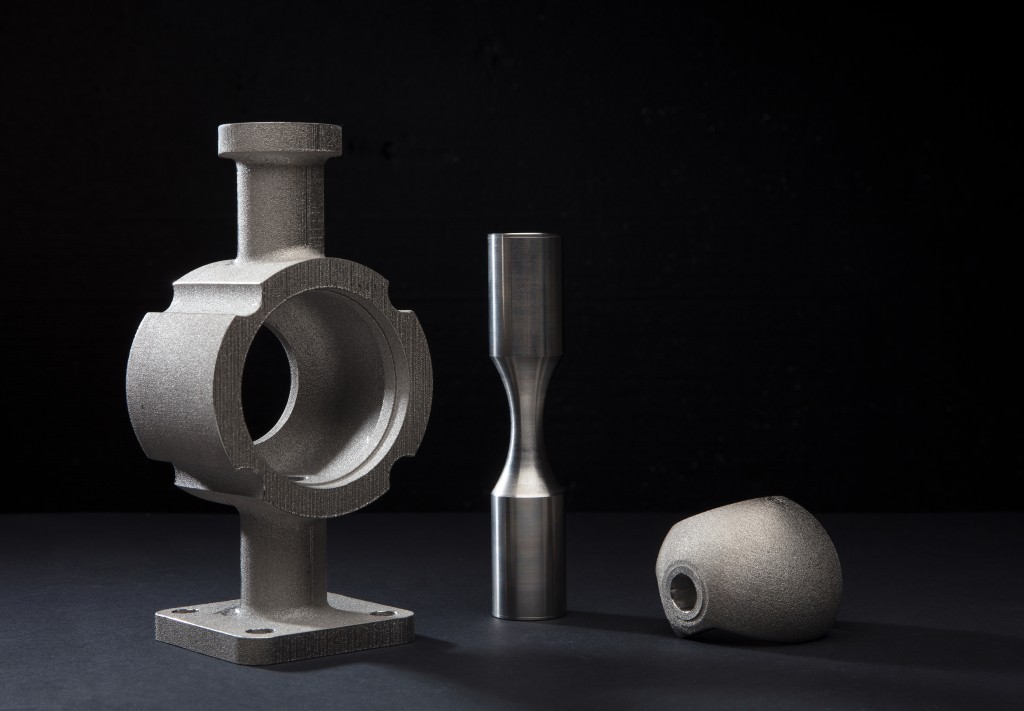
Ti6Al4V built with E-PBF (electron beam powder bed fusion, also known as EBM) meets the ASTM F2924 and ASTM F3001 requirements straight from the machine, with no heat treatment. Tensile strength is typically around 1,000 MPa and elongation well above the 10 % minimum, comparable to annealed wrought Ti6Al4V. The results below come from nearly 400 tensile samples, combining AIM’s own machine qualification with Colibrium Additive’s process verification.
New to the process? Start with What is E-PBF (electron beam powder bed fusion)?.
Measured properties
Ti6Al4V built on a Colibrium Additive Spectra L, tensile tested to ASTM E8M. Values are averages.
Average tensile properties of Ti6Al4V built on a Colibrium Additive Spectra L, tested to ASTM E8M, 397 samples in total. The lime line marks the ASTM minimum for each grade. Dark bars: Vertical (Z). Teal bars: Horizontal (XY). Lime markers: ASTM minimum.
Parameters | Grade | Condition | Build direction | Samples | Yield strength | Tensile strength | Elongation |
|---|---|---|---|---|---|---|---|
70 µm (line melt) | 5 | As built | Vertical (Z) | 45 | 973 MPa | 1,043 MPa | 17.1 % |
70 µm (line melt) | 5 | As built | Horizontal (XY) | 36 | 941 MPa | 1,017 MPa | 16.8 % |
70 µm (line melt) | 23 | As built | Vertical (Z) | 124 | 913 MPa | 989 MPa | 16.2 % |
70 µm (line melt) | 23 | As built | Horizontal (XY) | 68 | 892 MPa | 973 MPa | 14.4 % |
70 µm (line melt) | 23 | HIP | Vertical (Z) | 15 | 851 MPa | 922 MPa | 17.3 % |
70 µm (line melt) | 23 | HIP | Horizontal (XY) | 12 | 849 MPa | 928 MPa | 17.7 % |
50 µm (point melt) | 23 | As built | Vertical (Z) | 57 | 938 MPa | 1,006 MPa | 13.4 % |
50 µm (point melt) | 23 | As built | Horizontal (XY) | 40 | 933 MPa | 1,011 MPa | 12.7 % |
ASTM F2924 minimum | 5 | 825 MPa | 895 MPa | 10 % | |||
ASTM F3001 minimum | 23 | 795 MPa | 860 MPa | 10 % |
In total 397 samples. The 70 µm data combines AIM’s machine qualification (Grade 5 and Grade 23, 135 samples) with Colibrium Additive’s process verification (Grade 23, 165 samples). The 50 µm data is from Colibrium Additive’s process verification (Grade 23, 97 samples).
Other results, AIM qualification | Value |
|---|---|
Density, as built | 99.7 to 99.8 % |
Microstructure | α+β, no α-case |
Chemical composition | Within ASTM F2924 and F3001 for all loads |
Builds | 10, over 4 machine loads |
Deviations from protocol | 0 |
“As built” means straight from the machine, with no heat treatment.
Why E-PBF titanium is ductile as built
The E-PBF powder bed is held at around 700 °C for the whole build. Each layer cools slowly in that heat, and Ti6Al4V forms a fine α+β microstructure directly, the same phase structure as annealed wrought material. That is why elongation is well above the 10 % minimum without any heat treatment.
Laser powder bed fusion (L-PBF) melts into a near-room-temperature bed. The fast cooling forms α′ martensite, which is strong but less ductile, and L-PBF titanium is normally stress relieved or annealed after the build. After that heat treatment, the two processes land in a broadly comparable property class. The E-PBF route gets there with one process step fewer.
Consistent from build to build
The qualification was set up to test the conditions met in real production, not just a best case.
Full and back-to-back builds. With plate-free start, a new build job can be started on top of the previous one without unloading the machine. Grade 5 properties were consistent between a single full-height build (971 MPa yield, 1,039 MPa tensile) and back-to-back builds (930 to 975 MPa yield, 1,015 to 1,040 MPa tensile).
Worst case for Grade 23. Low oxygen content, a cathode late in its life and HIP all tend to lower yield strength. The Grade 23 load combined all three: 0.09 % oxygen, cathode at 632 to 701 hours, and a HIP batch. The results were still above the ASTM F3001 minimums, and even above the stricter Grade 5 minimums in ASTM F2924.
Grade 5 or Grade 23?
Both grades are Ti6Al4V. Grade 23 (ELI, extra low interstitial) has tighter limits on oxygen and iron, which gives somewhat lower strength but better ductility and fracture toughness. Grade 23 is the usual choice for orthopedic implants. Grade 5 gives higher strength and is common for industrial parts.
Grade 5 | Grade 23 (ELI) | |
|---|---|---|
Specification for powder bed fusion | ASTM F2924 | ASTM F3001 |
Oxygen limit | 0.20 % | 0.13 % |
Strength | Higher | Somewhat lower |
Ductility and toughness | Good | Better |
Typical use | Industrial parts | Orthopedic implants |
Line melt or point melt?
Point melting fuses the powder through individual points instead of continuous lines, with 50 µm layers. Compared with 70 µm line melt:
Strength. For Grade 23, point melt gives about 25 to 40 MPa higher yield strength (933 to 938 against 892 to 913 MPa). The builds used different powder lots, so part of the difference may come from the powder.
Ductility. Elongation is lower with point melt (around 13 % against 14 to 16 %).
Build rate. Line melt with 70 µm layers builds faster, which lowers the cost per part.
Both are well above the ASTM minimums, and the choice is made per part. More in What is point melt, and when can a part be built without supports?.
Does build direction matter?
Less than many expect. Yield and tensile strength differ by only a few percent between samples built vertically (Z) and horizontally (XY). With line melt, vertical samples are slightly stronger and slightly more ductile. With point melt, the two directions are almost identical. A likely reason is that melting point by point spreads the energy more evenly through each layer. All directions are well above the ASTM minimums.
What HIP does
Hot isostatic pressing (HIP) applies high temperature and gas pressure to the finished part to close internal porosity. In AIM’s qualification, HIP lowered Grade 23 strength slightly (yield from 876 to 850 MPa) and raised elongation (from 16.0 to 17.5 %). These figures are from AIM’s worst-case load alone, built with low-oxygen powder, so the as-built values are lower than the averages in the table above, which also include Colibrium Additive’s data. Both conditions are well above the ASTM F3001 minimums.
The main reason to HIP is fatigue. Internal pores can act as crack starters under cyclic load, so HIP is common for fatigue-critical parts, from both E-PBF and L-PBF. Since E-PBF builds in vacuum, no process gas is trapped in the material during the build, which helps HIP close the remaining pores.
Fatigue
Fatigue specimens of HIPed Grade 5 Ti6Al4V, built vertically with the 70 µm parameters (line melt) and then machined and polished, were tested by an accredited laboratory to DIN 50100. With fully reversed loading (R = -1) at ±500 MPa, all 6 specimens, from two separate builds, ran out to 10 million cycles without failure.
Fatigue test | Result |
|---|---|
Material | Ti6Al4V Grade 5, HIP |
Build | 70 µm parameters (line melt), vertical, 2 separate builds |
Specimens | Machined and polished, Ø6 mm, to DIN 50100 |
Loading | Fully reversed (R = -1), stress controlled |
Stress amplitude | ±500 MPa |
Result | 6 of 6 run out at 10 million cycles |
That is in line with the fatigue strength usually quoted for annealed wrought Ti6Al4V. Since no specimen failed, ±500 MPa is a lower bound, not the fatigue limit of the material.
In a real part, fatigue strength depends more on the part than on the process. The main drivers are:
Surface. As-built roughness is the most common crack starter. Machined or polished surfaces perform much better.
Internal porosity. HIP closes most internal pores.
Design. Notches, sharp transitions and the geometry of porous structures concentrate stress.
For fatigue-critical parts, the usual route is HIP plus machining of the critical surfaces, whichever powder bed process is used. Fatigue properties are then verified for the specific part and load case.
Standards and qualification
ASTM F2924 and ASTM F3001 cover Ti6Al4V made by powder bed fusion with either an electron beam or a laser. Choosing E-PBF does not mean choosing a process outside the established standards framework. Acceptance criteria are the same.
AIM’s Spectra L qualification followed a formal protocol with defined acceptance criteria, sample traceability to powder batch and build, and a full report. Production build jobs are then frozen, so every part is built the way the process was validated.