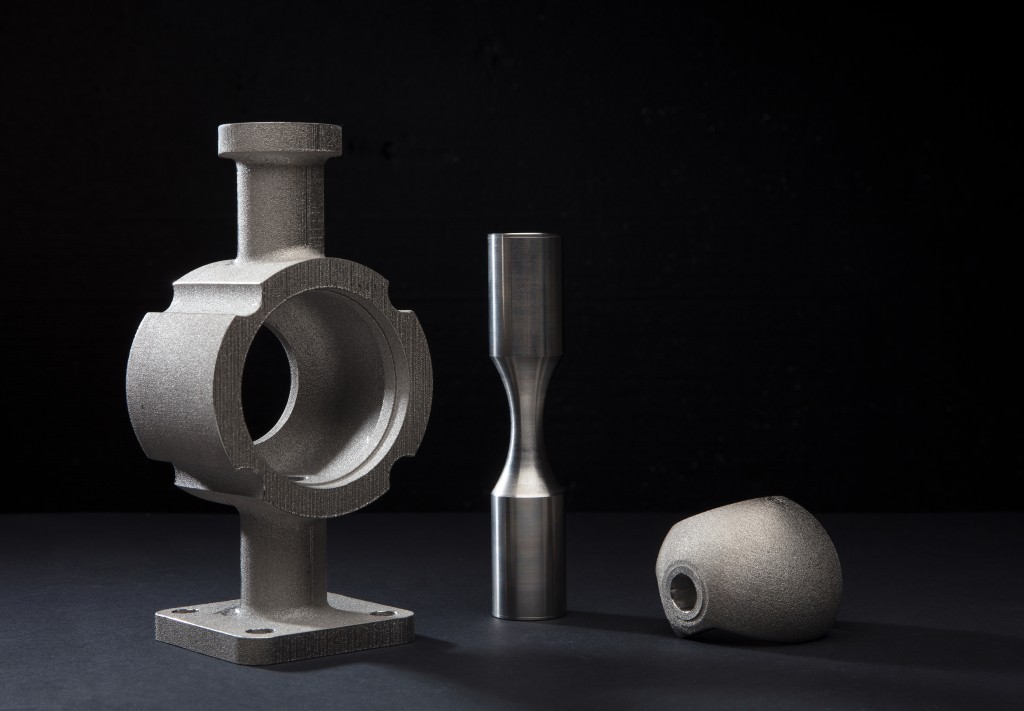
E-PBF (electron beam powder bed fusion) is a metal additive manufacturing process in which an electron beam melts metal powder layer by layer, in vacuum, inside a powder bed held at around 700 °C. Because the whole build stays hot, titanium parts come out essentially free of residual stress, and the surrounding powder sinters into a solid cake that holds the parts in place. That makes E-PBF well suited to serial production of titanium components such as orthopedic implants, impellers and housings.
The process is also known as EBM (electron beam melting) and EB-PBF. In ISO/ASTM 52900 it is designated PBF-EB/M (powder bed fusion, electron beam, metals).
How E-PBF works
An E-PBF build follows the same basic cycle as any powder bed process, with one important difference: the temperature of the powder bed is actively controlled in every layer, from the first to the last.
Before the build. The build chamber is pumped down to vacuum, with a small partial pressure of helium during the build. The vacuum lets the electron beam travel without scattering and keeps reactive metals such as titanium clean. The beam then heats the build platform up to process temperature.
The layer cycle. Each layer goes through the same five steps.
Powder layer. A rake spreads a thin layer of metal powder, typically 50 to 100 µm thick, across the build area.
Preheat. A defocused beam sweeps the fresh layer at high speed and lightly sinters the powder. Sintering makes the powder bed electrically conductive, so the charge the electron beam brings in can drain away. Without it, the particles would charge up, repel each other and scatter as a powder cloud, known as “smoke”, and the layer would be lost.
Melt. The beam focuses and melts the cross-section of each part in that layer. The beam is steered by electromagnetic coils, not mirrors, so it can move very fast and keep several melt pools going at once.
Temperature control. After melting, the machine either adds heat with the beam or idles to let the bed cool, so the build stays at the target temperature for the material. For Ti6Al4V that is around 700 °C. Every layer is built under the same thermal conditions.
Lower and repeat. The build platform lowers by one layer and the cycle starts again, until the parts are complete.
After the build. The block of sintered powder (the cake) cools down. Parts are freed by blasting, and the loose powder is recovered and reused under controlled conditions.
Key characteristics
Characteristic | E-PBF |
|---|---|
Energy source | Electron beam, 3 to 6 kW depending on system |
Atmosphere | Vacuum with helium partial pressure |
Powder bed temperature | Around 700 °C for Ti6Al4V |
Powder particle size | 45 to 106 µm |
Layer thickness | 50 to 90 µm |
Residual stress as built | Essentially none, no stress-relief heat treatment needed |
Part fixation | Held by the sintered powder cake, no need to anchor to the build platform |
Main materials | Ti6Al4V Grade 5 and Grade 23 (ELI) |
Material standards | ASTM F2924 (Ti6Al4V), ASTM F3001 (Ti6Al4V ELI) |
Typical build envelope | Up to Ø350 × 430 mm |
What the hot powder bed means for the part
Most of what sets E-PBF apart follows from the temperature of the powder bed.
Stress-free as built. Ti6Al4V is normally stress relieved at roughly 480 to 650 °C. An E-PBF build runs at around 700 °C, so the part is effectively annealed throughout its own build. It can go straight from the machine to machining with no stress-relief cycle in between.
Stable microstructure. The slow cooling in a hot bed gives Ti6Al4V a ductile α+β microstructure directly. Laser powder bed fusion (L-PBF), which melts into a cold bed, produces a harder, less ductile martensitic structure that is usually heat treated afterwards.
The sintered cake carries the part. The preheated powder forms a coherent, heat-conducting cake around the parts. Nothing has to be anchored to the build platform, so parts can be stacked in several levels through the full build height. That is the main reason E-PBF suits serial production: the fixed cost of each build is shared across many more parts.
Supports are a choice, not a requirement. Since the cake holds the part and conducts heat away, supports are not needed to restrain stress or anchor the part. They become a per-part decision. A few well-placed supports can make a build faster and cheaper; leaving them out gives a clean as-built surface or allows a denser stacked build. Read more in Supports in E-PBF: a choice, not a requirement.
Coarser powder: lower cost, rougher surface
E-PBF uses coarser powder than L-PBF (45 to 106 µm against around 25 to 63 µm). Coarse powder is cheaper to produce, flows well and is easier to handle safely. The trade-off is a rougher as-built surface and a larger minimum feature size. Functional surfaces are machined, which is standard practice for both processes on critical faces. For the numbers, see What feature sizes can E-PBF achieve in titanium?.
E-PBF, EBM, EB-PBF and PBF-EB/M: what is the difference?
All four names describe the same process.
E-PBF is the common short form, and the one AIM uses.
PBF-EB/M is the formal designation in ISO/ASTM 52900.
EB-PBF is a widely used short form in research literature, and the one Colibrium Additive uses.
EBM (Electron Beam Melting) is the original trade name from Arcam, the Swedish company that commercialized the technology. Arcam is now part of Colibrium Additive, a GE Aerospace company.
When E-PBF is the right choice, and when it is not
E-PBF is a strong fit when a titanium part is bulky, when many parts can be stacked in one build, when the route from machine to finished part should be short, or when ductility in the delivered condition matters.
It is not the best fit for every part. Very thin walls, very fine features, a fine as-built surface without machining, or narrow enclosed internal channels usually point to L-PBF or to conventional machining. An honest feasibility assessment at the start saves time on both sides. The two processes are compared in detail in E-PBF vs L-PBF for orthopedic implants and E-PBF vs L-PBF for industrial titanium parts.
Where E-PBF is used
Orthopedic implants. Acetabular cups, spinal implants and other implants with porous or trabecular bone-ingrowth surfaces, in serial production since the late 2000s.
Industrial titanium parts. Impellers, valve bodies, housings, brackets and other bulky parts for energy, aerospace, defense and automotive.
Tooling. Titanium forming screens for molded fiber packaging, such as AIM’s FreeFlow® tooling.
E-PBF at AIM
AIM is a contract manufacturer dedicated to E-PBF of titanium, with production in Östersund, Sweden.
Six industrial E-PBF systems from Colibrium Additive: 2× Q10plus, 3× Q20plus and 1× Spectra L
70,000+ orthopedic implants delivered in serial production since 2018
ISO 13485 certified since 2017, ISO 9001 since 2021, AS9100 in progress
Engineering support from feasibility and design for additive manufacturing through process development, qualification and serial production