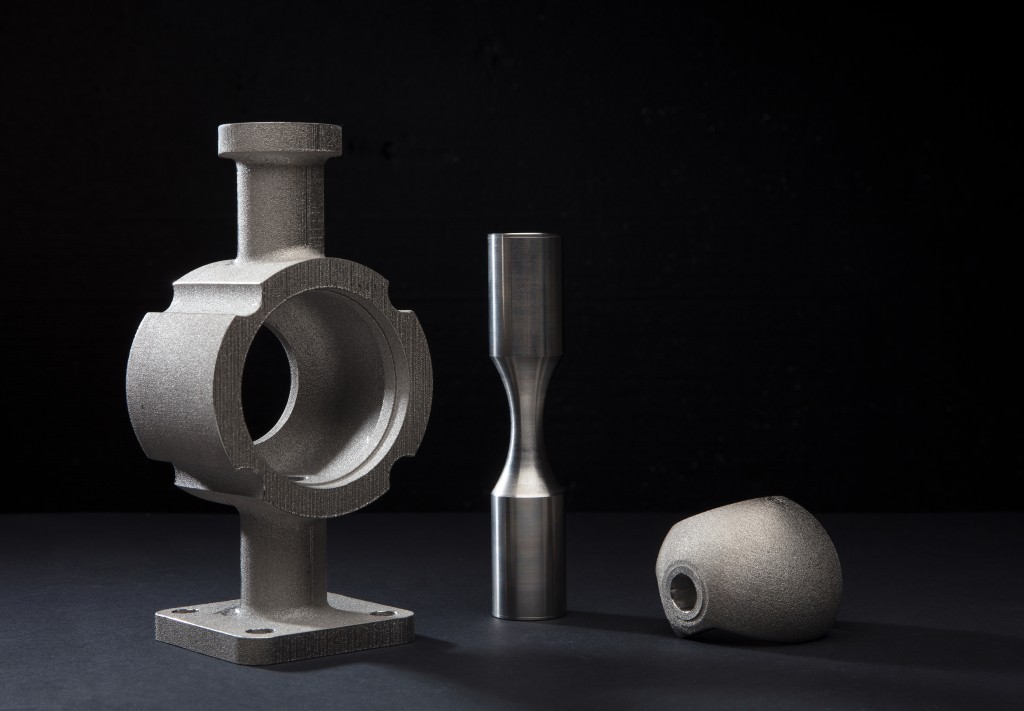
In E-PBF (electron beam powder bed fusion, also known as EBM), the sintered powder cake carries the part, so supports are never needed to hold it in place. Whether to use supports is a per-part trade-off between cost and capability. Supports allow a faster build with 70 µm layers and a lower cost per part. Leaving them out, with point melt, gives clean down-facing surfaces and more freedom in orientation, but the build takes longer.
New to the process? Start with What is E-PBF (electron beam powder bed fusion)?.
Why laser powder bed fusion needs supports
In laser powder bed fusion (L-PBF), the powder bed sits near room temperature. Each melted layer cools fast and shrinks against the cold material below, which builds up residual stress. Supports have two jobs there: they anchor the part to the build platform so it does not distort or lift, and they carry energy away from overhangs into the platform.
That is why every L-PBF part is built on supports, and why the parts sit in a single level on the build platform. After the build, the parts are stress relieved, cut off the platform and the supports are removed by hand or by machining.
Why E-PBF does not
E-PBF works differently in two ways:
The part is held by the powder. Before each layer is melted, the powder is lightly sintered. The result is a solid powder cake around the parts that holds them in place, so nothing has to be anchored to the build platform.
There is almost no residual stress. The powder bed is held at around 700 °C for the whole build, so the part comes out essentially stress-free. There is nothing for supports to restrain.
Since supports are not needed to hold the part, they become an option, not a requirement.
What supports still do in E-PBF
Where supports are used in E-PBF, they mainly do one thing: carry energy away from large inclined or down-facing surfaces. Under an overhang, the new layer is melted on top of powder, which conducts far worse than solid titanium. A few supports there give the energy a way out, which allows faster parameters and a good down-facing surface. These supports do not have to reach down to the build platform. They work as heat sinks in the powder below the surface: with the 70 µm parameters (line melt), a standard support is 20 mm long.
Since E-PBF supports only carry energy, not stress, they are typically lighter and easier to remove than supports in L-PBF.
With point melt, energy and cooldown can be controlled for every point, so down-facing surfaces can also be built without supports. More in What is point melt, and when can a part be built without supports?.
Where supports are still wanted, point melt also reduces how many are needed. In AIM’s point melt projects, supports could be placed at a lower angle and spaced more sparsely, and support needs were mapped over the entire build area. More in How long has AIM worked with point melt?.
The trade-off: cost or capability
With supports | Without supports | |
|---|---|---|
Parameters | 70 µm (line melt) | 50 µm (point melt) |
Build speed | Faster | Slower |
Cost per part | Lower | Higher |
Down-facing surfaces | Good, supports removed after the build | Clean, as built |
Post-processing | Support removal | None for supports |
Orientation freedom | Good | Greater |
Best suited to | Larger parts, and parts where build time drives cost | Smaller parts, and parts where surface or geometry drives value |
Building without supports is slower and therefore more expensive, so it suits mainly smaller parts, where build time is not the main cost driver. For larger parts, a few well-placed supports are often the better choice.
Two examples
Hip cups are built with the 70 µm parameters (line melt), with supports where they make the build faster.
Hip cup, with supports. A hip cup runs with supports on the 70 µm parameters (line melt). The cup is relatively large, and build time drives its cost. Importantly, the supported surface is machined afterwards anyway, so the supports add almost no extra work. A faster build with a few supports gives the lowest cost per implant.
Spine implant, without supports. A spine implant can be built without supports using the 50 µm parameters (point melt). The part is small, so the longer build adds little cost, while the as-built surface and the freedom in orientation add value.
How AIM makes the call
The choice is made per part, together with the customer, early in the project. The questions that usually decide it:
How large is the part, and how many fit in a build? The larger the part, the more build time weighs in the cost.
Which surfaces face down, and do they matter? If a down-facing surface is machined afterwards anyway, supports there cost little.
Can supports be reached for removal? Supports in places that are hard to reach speak for point melt.
What does the part need to cost at volume? The cost target often settles it.