For industrial titanium parts, the choice between E-PBF (electron beam powder bed fusion, also known as EBM) and L-PBF (laser powder bed fusion) comes down to the geometry. E-PBF suits bulky, thick-walled parts and batches of similar parts: it builds in a hot powder bed, so parts come out essentially free of residual stress and go straight to machining. L-PBF suits thin walls, fine internal channels and smooth as-built surfaces. Both processes meet the same material standards for Ti6Al4V, so the question is not which process is better, but which one fits the part.
New to the process? Start with What is E-PBF (electron beam powder bed fusion)?.
The short comparison
E-PBF | L-PBF | |
|---|---|---|
Energy source | Electron beam, in vacuum | Laser, in argon |
Powder bed temperature | Around 700 °C | Near room temperature |
Residual stress as built | Essentially none | High, stress relief needed |
How parts are held | In the sintered powder cake, stacked in several levels | Anchored to the build platform in one level |
Supports | A choice, decided per part | Required for anchoring and heat removal |
Risk of distortion in large parts | Low | Grows with part size |
Thinnest wall, as built | Around 0.75 mm | Around 0.2 mm |
As-built surface roughness, Ra | 12 to 30 µm, depending on orientation | 5 to 15 µm |
Internal channels | Must be open and large enough to blast clean | Fine channels possible, loose powder pours out |
Material standards for Ti6Al4V | ASTM F2924, ASTM F3001 | ASTM F2924, ASTM F3001 |
Residual stress: the difference that drives the rest
In L-PBF, each layer is melted into a powder bed near room temperature. The melt cools fast and shrinks against cold, solid material below it, which locks in residual stress. Published measurements on as-built L-PBF Ti6Al4V report residual stress of several hundred MPa. That is why L-PBF parts are anchored to the build platform with supports, and stress relieved before they are cut off. Cutting a part free first would let the stress turn into distortion.
In E-PBF, the powder bed is held at around 700 °C for the whole build. That is above the temperature where Ti6Al4V is normally stress relieved, so the stress is relaxed as the part is built. The part comes out essentially stress-free, with a ductile α+β microstructure, and needs no stress-relief cycle.
For small parts, this is a difference in process steps. For large and bulky parts, it decides how much risk the build carries.
Why part size matters
A bulky titanium valve body built with E-PBF.

Residual stress builds up over the length and cross-section of a part. The larger and thicker the part, the more force the supports in L-PBF have to hold, and the higher the risk of distortion, cracking or a part pulling loose during the build. When that happens late in a long build, the whole build is lost.
E-PBF does not have that build-up. A thick flange, a solid hub or a heavy housing is built the same way as a thin bracket. The main risks shift from mechanical to thermal, and those are handled through the build strategy. That makes E-PBF a natural fit for bulky titanium parts: impellers, housings, valve bodies, manifolds with large passages, brackets and fittings.
On AIM’s Colibrium Additive Spectra L, parts up to Ø350 mm and 430 mm in height can be built.
Supports are a choice, not a requirement
Two valve bodies being blasted free of the sintered powder cake. During the build, the cake held them in place.

In L-PBF, supports anchor the part against residual stress and carry heat to the build platform, so every part is built on them. On large titanium parts, removing supports is often one of the largest labor costs.
In E-PBF, the sintered powder cake holds the part and conducts heat away, and there is almost no stress to restrain. Supports are used where they make the build faster and cheaper, mainly under large down-facing surfaces, and left out where they do not pay off. With point melt, down-facing surfaces can also be built without supports. More in Supports in E-PBF: a choice, not a requirement.
Batches: stacked builds
Since E-PBF parts are held by the powder cake, they can be stacked in several levels through the full build height. In L-PBF, every part needs its own connection to the build platform, so a build is essentially one level of parts.
For batches of similar parts, such as brackets, fittings or small housings, more parts per build means the fixed cost of each build (heating, cooling, powder handling, changeover) is shared across more parts. AIM has produced thousands of titanium automotive parts this way in serial production.
Straight to machining
Most industrial titanium parts have machined interfaces: sealing faces, bores, threads and mating surfaces. The as-built E-PBF surface is rougher than L-PBF, so functional surfaces are given a machining allowance, typically around 1 mm. On a bulky part with a few machined interfaces, that allowance is a small cost.
Since the part comes out stress-free, it can go from the build to machining with no stress-relief cycle and no cutting from a build platform. Each step removed is one less process to qualify, schedule and document.
Mechanical properties, HIP and standards
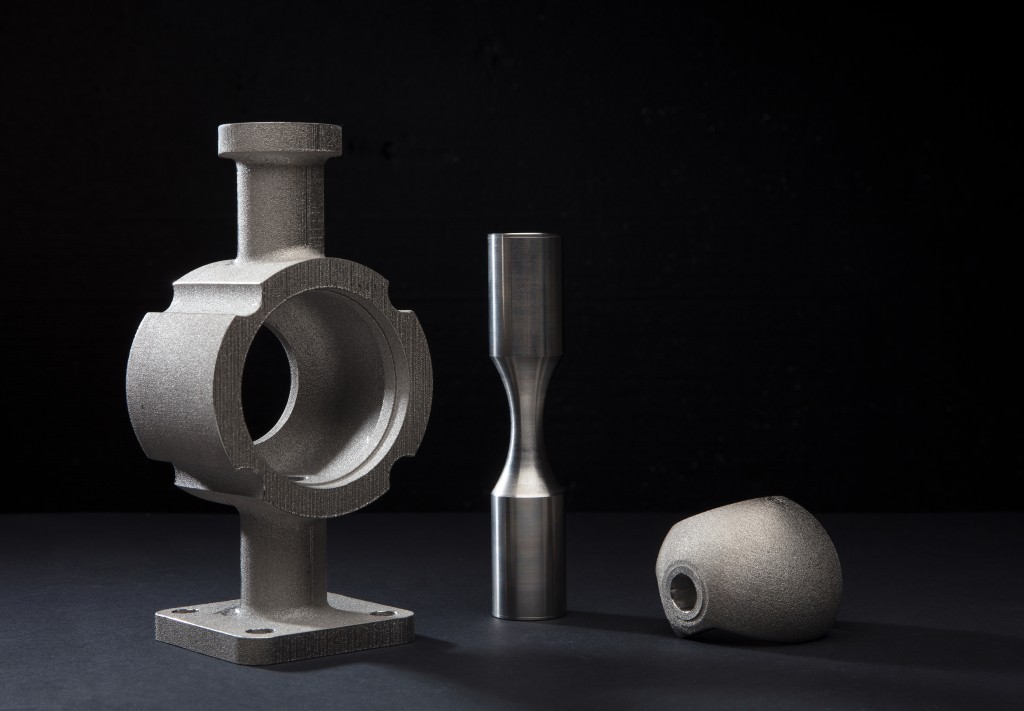
A valve body built with E-PBF, next to a machined tensile test bar.

E-PBF Ti6Al4V meets ASTM F2924 (Grade 5) and ASTM F3001 (Grade 23) as built, with tensile strength typically around 1,000 MPa and elongation well above the 10 % minimum. L-PBF Ti6Al4V is stronger but less ductile as built, and is normally heat treated, after which the two land in a broadly comparable property class.
For fatigue-critical parts, hot isostatic pressing (HIP) and machining of critical surfaces are the usual route for both processes. Since E-PBF builds in vacuum, no process gas is trapped in the material during the build. In AIM’s testing, HIPed and machined Grade 5 specimens ran out at ±500 MPa with fully reversed loading to 10 million cycles. Details in What mechanical properties does E-PBF Ti6Al4V have?.
Example: closed impellers
A closed (shrouded) compressor impeller is close to the ideal E-PBF part. It is bulky, with a solid hub and thick sections, and its flow channels are enclosed by the shroud, which makes it hard to machine from solid. The channels are large enough for the sintered powder to be blasted out. The impeller comes out stress-free, is HIPed and then machined on its interfaces. AIM delivers closed titanium impellers in serial production. More in Can closed impellers be made with E-PBF?.
When L-PBF is the better fit
An honest comparison has to say where the other process wins. L-PBF is usually the better choice for:
Walls thinner than about 0.75 mm, or very fine features
Fine or winding internal channels, such as conformal cooling, and compact heat exchangers, where the powder has to be removed from narrow passages
Smooth as-built surfaces that will not be machined
Materials outside the E-PBF range, such as aluminum alloys and many steels. AIM builds in Ti6Al4V.
Small parts in small batches, where a single level of parts already fills the build economically
If a part falls into one of these groups, AIM will say so early.
Industrial titanium parts at AIM
AIM builds titanium parts for energy, defense, aerospace and automotive customers, from feasibility to serial production.
Six E-PBF systems from Colibrium Additive: 2× Q10plus, 3× Q20plus and 1× Spectra L
Closed impellers, valves and other bulky titanium parts delivered in serial production
ISO 9001 certified since 2021, AS9100 certification in progress
Ti6Al4V Grade 5 and Grade 23, as built or HIPed
Support from design for additive manufacturing through process development, qualification and serial production
A good first step is a feasibility review: share a part and AIM will come back with an honest assessment of process choice, build strategy, cost and lead time.